"I've worked with AI for over 15 years. I have to laugh when people talk about AI like it's new, or when they tell me they 'use ChatGPT' as their AI friend. AI isn't new. What's new is accessibility and production-ready deployment at scale. Organizations treating this as a novelty or a casual tool miss the strategic transformation happening right now. This isn't about having an AI assistant. It's about fundamentally restructuring how businesses operate and compete."
What Separates Successful AI Implementations in the First 90 Days
Organizations capturing value share one characteristic.
They identified specific operational pain points with measurable costs before vendor conversations.
These organizations start with defined problems, not exploration. They know where inefficiency bleeds revenue. They know where manual processes create bottlenecks.
Take a logistics company with a clear problem: lead qualification took 72 hours while competitors responded in 24.
This is an implementation target.
Compare this to a mid-market retail client who wanted "AI transformation" but couldn't articulate what specific process was costing them opportunities.
The retail client? Stalled.
The logistics company? Deployed a predictive lead scoring system in six weeks, reduced response time to 18 hours, and increased conversion rates 34% within five months.
The difference?
Organizations consume vendor promises about theoretical capabilities instead of mapping operational workflows to identify where autonomous systems create immediate value.
"The organizations capturing value in our implementations are the ones who come to us with a defined problem, not a vague aspiration. They've done the internal work to identify where inefficiency is costing them revenue or competitive position. That clarity accelerates everything. We're seeing these organizations deploy in 6-12 weeks and capture measurable ROI in under six months because they started with the right question."
📌 Implementation Framework
Value capture begins with specific, measurable operational pain points. Organizations starting with "AI exploration" stall. Organizations starting with "72-hour lead qualification costs deals" deploy in weeks, capture value in months.
Why Technical Success Doesn't Equal Operational Adoption
Technical deployment happens fast. The logistics company's AI system integrated with their CRM in six weeks and functioned exactly as designed.
Week eight? The obstacle hit.
Not technical.
The sales team had spent years developing intuition about lead prioritization. They built informal systems, personal spreadsheets, gut-feel processes. Then the AI started flagging leads they would have deprioritized.
Those leads converted.
Resistance emerged.
The top performer felt threatened. A system was outperforming his instinct.
Management hadn't prepared for the psychological shift.
They budgeted for technology implementation but not for human transition. The project paused for three weeks of adoption workshops, reframing the AI from "better at qualification" to "handles pattern recognition so you focus on relationship building."
This is organizational debt. Organizations pay for expensive technology and expensive human processes because nobody commits to the transition fully. Organizations get the efficiency of neither.
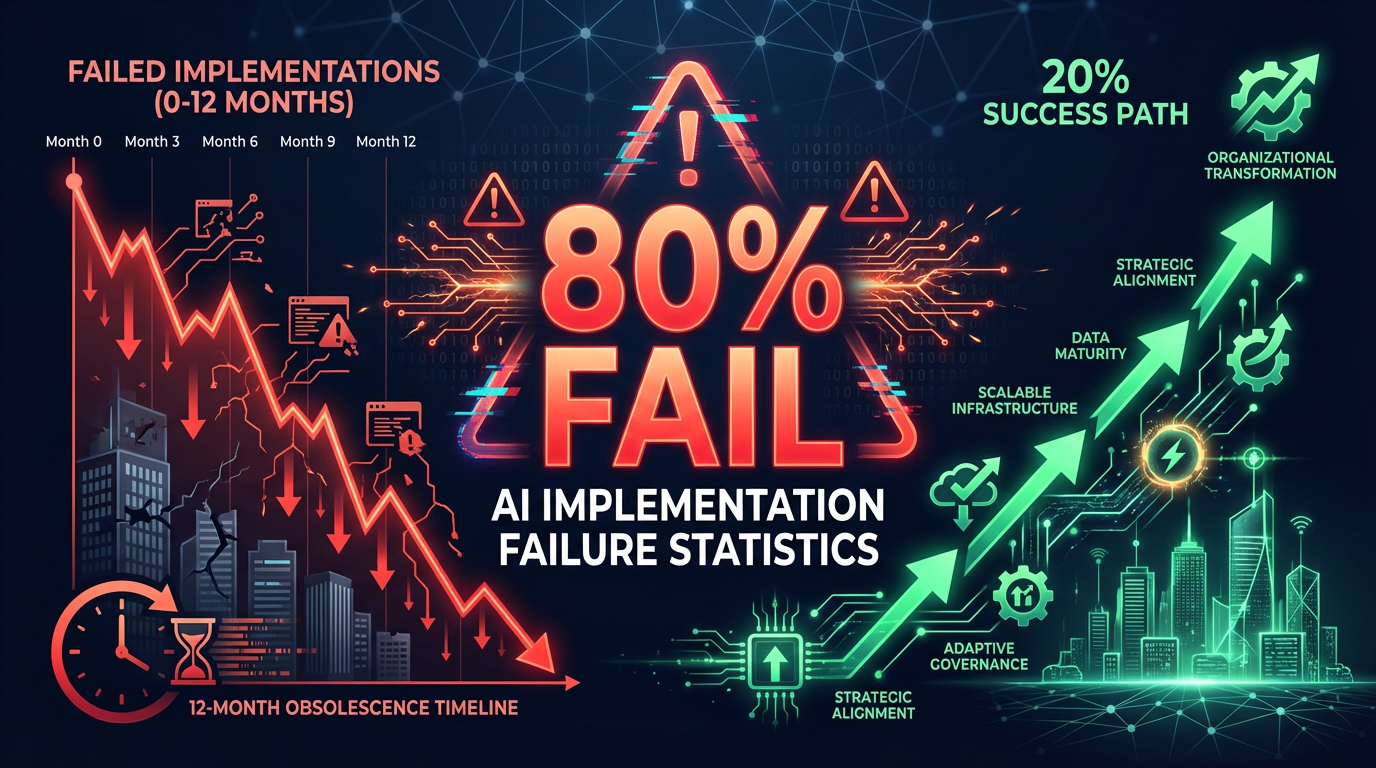
Research confirms this pattern: change management projects have a failure rate around 70%. AI implementations? 80%. Not because of technical inadequacy. Because of organizational unreadiness.
📌 Implementation Framework
The gap between technical deployment and organizational adoption is where implementations stall. Organizations measuring success by technical milestones instead of adoption rates, process abandonment, and behavior change face failure.
How High Performers Become Implementation Blockers
AI deployment exposes an uncomfortable reality.
Significant portions of what high performers are valued for (pattern recognition, data synthesis, qualification logic) get systematized once you map the decision trees.
Their expertise wasn't illegitimate.
It was replicable by algorithms.
This creates dangerous organizational moments. High performers have political capital, relationships with leadership, and credibility to slow implementations by raising concerns about accuracy, client relationships, or brand risk.
Take a financial services client with a senior analyst who spent 15 years building credit risk assessment expertise.
The AI system matched his accuracy in weeks.
What happened? He became the loudest voice questioning model reliability, demanding endless validation cycles, raising edge cases.
Was he wrong to be rigorous? No. But the subtext was protecting organizational value.
How do organizations navigate this successfully?
Two things:
First, they communicate upfront AI will automate pattern recognition work. They redefine high performer value around judgment, client relationships, strategic thinking (the things algorithms don't replicate yet).
Second, they involve high performers in training and validating AI systems, giving them ownership instead of displacement.
The logistics company's top performer? Became an advocate after repositioning as the "AI optimization specialist" who trained the system on edge cases and complex scenarios the algorithm couldn't handle alone.
Some roles will be compressed or eliminated. The banking sector demonstrates this reality.
📌 Implementation Framework
Organizations navigate high performer resistance by redefining roles around judgment and strategic thinking while involving them in AI training. Organizations ignoring this dynamic face political blockers who slow implementations indefinitely.
What Banking Sector Job Displacement Reveals About AI Economics
The numbers tell the story.
More than 200,000 European banking jobs will vanish by 2030 as lenders implement AI and close physical branches, according to Morgan Stanley analysis.
The displacement is immediate. Dutch lender ABN Amro plans to cut one-fifth of its staff by 2028. Société Générale's CEO has declared "nothing is sacred."
The rollout of agentic AI workflows enables a single human supervisor to oversee 20 to 30 autonomous AI agents managing complex, end-to-end processes. McKinsey estimates this drives up to 20% in net cost reductions for the industry.
Actual deployments show measurable results:
- JPMorgan Chase reported productivity rising to 6%, with operations specialists expected to see gains of 40 to 50%
- Citigroup cited a 9% increase in coding productivity
- 54% of financial jobs have high automation potential—more than any other sector
The decision framework organizations use is straightforward: timeline pressure and whether leadership views workforce as an asset to evolve or a cost to optimize.
Why Organizations Choose Cost Optimization Over Workforce Transition
Organizations facing immediate margin pressure, activist investors, or sectors where commoditization has eroded relationship value move toward reactive layoffs.
When competitors cut costs by 30% through AI automation and margins get squeezed? Workforce transition frameworks become unaffordable.
Picture the CFO showing a spreadsheet: "We're spending $4.2 million annually on this analyst team. The AI system costs $340,000 to implement and $80,000 yearly to maintain. We deploy in Q2 or we miss efficiency targets."
In banking, when competitors automate loan processing and offer faster decisions with lower fees? Organizations either match efficiency or lose market share.
📊 Key Finding
Around 76% of banks expect to increase tech headcount because of agentic AI, becoming more selective by hiring fewer people with deeper skill sets.
📌 Implementation Framework
Banking sector displacement reveals AI economics clearly. One supervisor oversees 20-30 autonomous AI agents. Organizations face straightforward calculations: $4.2 million in annual analyst costs versus $340,000 implementation plus $80,000 yearly maintenance. Organizations must match competitor efficiency or lose market share.
How Human Oversight Functions as Temporary Liability Management
"Human oversight" sits on a spectrum.
It exists on a spectrum from genuine necessity to temporary liability management.
Organizations know which category they're in.
They won't say it publicly.
Where Oversight Remains Necessary
In compliance and content moderation, human oversight persists. Why? Because the cost of algorithmic errors (regulatory penalties or brand damage) exceeds labor savings.
A financial services client has agentic AI systems flagging suspicious transactions, but humans make final SAR filing decisions because false positives create legal exposure and false negatives create catastrophic liability.
The human isn't adding judgment the AI lacks.
Adding accountability and legal cover.
Oversight persists as long as regulators require a named individual responsible for compliance decisions.
Where Oversight Erodes Rapidly
In surveillance and monitoring applications? Human oversight requirements erode fast.
A retail client implemented inventory shrinkage monitoring with managers reviewing flagged incidents before action.
Within four months, once system accuracy was validated, they moved to automated alerts with human review only for termination decisions.
Within eight months? Even that review became perfunctory. Managers rubber-stamped AI recommendations because disagreeing required justifying why their judgment was better than the data.
Why Different Sectors Remove Oversight at Different Speeds
Healthcare maintains the longest oversight retention, not because medical organizations are more cautious about AI capability, but because malpractice liability and regulatory frameworks make human accountability legally non-negotiable.
Finance sits in the middle. High-stakes decisions like credit approvals or fraud detection keep human oversight longer because errors create direct financial loss or regulatory penalties. But back-office operations, reconciliation, reporting? That oversight layer disappears fast.
Manufacturing and logistics remove oversight fastest because errors are operationally contained and financially quantifiable.
Retail runs customer-facing decisions around pricing, inventory, personalization autonomously with minimal oversight because competitive pressure to optimize in real-time is intense and individual errors are low-stakes.
📌 Implementation Framework
Human oversight removal is determined by error cost versus oversight cost. Healthcare maintains oversight because malpractice liability exceeds labor savings. Manufacturing removes oversight in 90 days because error costs are less than supervision costs. The augmentation narrative is temporary liability management.
What Governance Architecture Replaces Human Oversight
What happens when human oversight gets removed?
Organizations accept algorithmic risk as operational risk and manage it the same way they manage any operational exposure: through monitoring, exception reporting, and financial reserves.
Organizations aren't building sophisticated governance architecture.
Building alert systems and setting error budgets.
Governance by Design vs. Governance by Oversight
Organizations doing this properly implement "governance by design" instead of "governance by oversight."
Building:
- Audit trails
- Version control for AI models
- Rollback capabilities
- Clear accountability frameworks for who owns system performance
A financial services client has a governance structure where the AI system operates autonomously, but a designated executive owner is responsible for system performance, quarterly model reviews, and defined escalation protocols when errors occur.
Real governance? Clear ownership, defined review cycles, documented decision-making authority.
📌 Implementation Framework
Organizations accepting algorithmic risk as operational risk build automated monitoring with threshold-based escalation, not sophisticated governance. Effective governance requires audit trails, version control, rollback capabilities, and clear accountability frameworks with designated executive ownership.
Why Companies Face 12-Month Obsolescence Timelines
A mid-market professional services firm chose firing and hiring over upskilling because management viewed AI as "ChatGPT."
This perspective reveals how deeply they misunderstand what's happening.
They have 12 months before obsolescence.
"I've worked with multinationals and global enterprises across different markets. What separates organizations that survive from those that don't is leadership strength. When management lacks the vision or courage to upskill their workforce, they default to the easiest path: letting people go. But they're not solving the competitiveness problem. They're accelerating their obsolescence."
The timeline isn't arbitrary. It's based on what their direct competitors are doing: deploying AI for operational efficiency while they're stuck in manual processes.
Where Fatal Ignorance Concentrates
Where does this pattern concentrate? Two places:
- Mid-market professional services (legal, consulting, accounting, marketing agencies)
- Small corporate companies in the 50-200 employee range operating in silos
These organizations have management teams that rose through the ranks doing things a certain way.
They don't understand AI isn't a tool.
AI is a fundamental restructuring of how work gets done.
📌 Implementation Framework
Organizations viewing AI as optional face 12-month obsolescence timelines. Competitors delivering services 40% faster at 30% lower cost through automation win bids. Organizations losing 2-3 deals per quarter face revenue decline forcing emergency cuts or acquisition within 12 months.
How Will HR Adapt When They Know Nothing About AI
The corporate service provider Lisa consulted with revealed a deeper problem: Human Resources operating with zero understanding of AI's impact on organizational structure, skills requirements, or talent strategy.
"HR was still recruiting for yesterday's roles while the business needed tomorrow's capabilities. They had no framework for identifying which positions would be augmented versus eliminated, no strategy for reskilling existing talent, no understanding of how to evaluate AI literacy in candidates. When I asked how they planned to recruit for AI-enhanced roles or develop transition pathways for displaced employees, I got blank stares."
This isn't an isolated case. HR departments across mid-market and small corporate companies are the most unprepared function for AI transformation.
What HR Needs to Become
HR departments need to transform from administrative gatekeepers to strategic workforce architects. This means:
- Skills mapping, not job descriptions - Map which tasks get automated, which get augmented, which remain human. Build skills inventories showing who has the adaptability, learning capacity, and technical literacy to transition.
- Internal mobility over external hiring - Organizations with strong internal mobility programs retain institutional knowledge while developing AI-ready talent.
- AI literacy assessment in recruitment - Assess comfort with AI-assisted workflows, ability to validate algorithmic outputs, willingness to let systems handle pattern recognition.
- Change management expertise - HR should be leading adoption strategy, designing transition frameworks, managing the psychological shift when roles get redefined.
📌 Implementation Framework
HR departments operating with traditional recruitment and administration models are unprepared for AI transformation. Organizations need HR to become strategic workforce architects who map skills, enable internal mobility, assess AI literacy, and lead change management. HR functions remaining in administrative roles will preside over organizational decline.
How China's AI Acceleration Compresses Competitive Timelines
China AI acceleration creates a two-front pressure system on Middle Eastern companies.
Western companies had the luxury of gradual AI adoption: experiment, fail, iterate over years.
Middle Eastern organizations? Now face mature AI capabilities from both Western vendors and Chinese technology providers entering the market with aggressive pricing and proven deployment models.
Investment Flow Infrastructure
📊 Key Numbers
- Over the past decade, China's government VC funds channeled $912 billion into strategic industries like AI
- 23% of government VC funding goes to AI-related firms
- State-led AI investment funds launched an $8.2 billion AI fund for startups in January 2025
- DeepSeek's DeepSeek-R1 model achieved GPT-4o-level performance with training cost under $6 million (less than 10% of U.S. counterparts)
The market impact was immediate: a massive sell-off on January 27 wiped out nearly $1 trillion in tech stocks, including $600 billion from Nvidia alone.
Chinese companies treat the Middle East as a strategic growth market, not a secondary territory. Establishing local partnerships, building Arabic language capabilities, and pricing aggressively to gain market share.
Middle Eastern companies now have access to enterprise-grade AI at mid-market prices.
This eliminates the "we can't afford it" excuse slowing adoption.
Why Middle Eastern Organizations Skip AI Exploration Phases
Western markets went through a long exploration phase: pilot projects, proof of concepts, innovation labs.
Middle Eastern organizations? Skip that entirely because they see what works. Going straight to production deployments of proven use cases.
A Dubai-based logistics company didn't waste time on AI experimentation.
Looked at what Amazon and Alibaba were doing with route optimization and demand forecasting, then implemented similar systems directly.
Late-mover advantage in action.
📌 Implementation Framework
Chinese AI providers offer production-ready systems at 60% of Western costs. DeepSeek achieved GPT-4o-level performance with training costs under $6 million (less than 10% of U.S. counterparts). Middle Eastern organizations access enterprise-grade AI at mid-market prices and skip exploration phases by deploying proven use cases directly.
What Actually Drives AI Procurement Decisions
The decision framework is more pragmatic than the public narrative suggests.
Three factors drive the decision: immediate cost savings, implementation speed, and which vendor relationship protects the decision-maker if something goes wrong.
How Survival Mode vs. Optimization Mode Drives Vendor Choice
Companies facing immediate competitive pressure (losing deals, seeing margin compression, watching competitors automate)? Choose based on speed and cost.
Take the Chinese system, implement in 12 weeks, and start capturing value immediately.
The geopolitical risk? Theoretical.
The competitive displacement? Happening now.
Companies operating from stability make the "safe" choice: Western providers, established vendors, premium pricing. Buying insurance against career risk for the executives making the decision.
The hybrid approach is most common: organizations use Western systems for customer-facing or sensitive applications where brand risk matters, and Chinese or regional providers for back-office operations where cost efficiency is the priority.
📌 Implementation Framework
Procurement decisions are driven by immediate cost savings, implementation speed, and which vendor relationship protects decision-makers. Organizations in survival mode choose based on speed and cost. Organizations in optimization mode buy career risk insurance through Western premium providers. Hybrid approaches use Western systems for customer-facing applications and Chinese providers for back-office operations.
What Organizations Fundamentally Misunderstand About AI Implementation
Here's the fundamental misunderstanding:
Organizations think they're implementing technology when they're restructuring power, authority, and organizational identity.
They budget for AI deployment as a technical project (software licenses, integration costs, training sessions) while missing they're asking people to accept their expertise, their decision-making authority, and their organizational value is being fundamentally redefined.
What will cost them isn't technology failing.
Organizational resistance they didn't plan for creating a zombie implementation where the AI works perfectly but nobody uses it.
How Organizational Debt Accumulates During AI Implementation
Paying for the AI system and still paying for the human processes because nobody commits to the transition fully.
A client spent $600,000 implementing predictive analytics for inventory management.
The system worked flawlessly.
But purchasing managers kept overriding the recommendations because "they knew the business better."
Nine months in? Paying for sophisticated AI and still operating on gut instinct. Got neither the efficiency of automation nor the reliability of their old system.
Just expensive paralysis.
📊 Research Validation
- Enterprises integrating change management are 47% more likely to meet their objectives
- 74% of leaders say they involve employees in change management
- Only 42% of employees say they were included
This leadership-employee perception gap creates the resistance documented throughout these implementations.
📌 Implementation Framework
Organizations budget for AI as technical projects while missing they're asking people to accept their expertise and authority is being redefined. The gap between "the system works" and "the organization uses the system" creates zombie implementations. Enterprises integrating change management are 47% more likely to meet objectives.
What Organizations Will Capture AI Value in the Next 12-18 Months
Organizations capturing value in the next 12-18 months aren't the ones with the most advanced AI.
They're the ones willing to have honest conversations about role transformation, authority redistribution, and what human contribution means when AI handles the pattern recognition work.
The technology? Ready.
The organizational structures, the change management frameworks, the leadership courage to say "yes, some roles will fundamentally change or disappear"? What's missing.
"This is one of the most compelling periods I've witnessed in business transformation. We're seeing AI capabilities once theoretical now deployed in production at accessible price points. Organizations approaching this strategically, with strong leadership and clear vision, are capturing 30-40% efficiency gains in 8-18 month timeframes. The technology isn't the constraint anymore. Leadership courage and organizational commitment to transformation is what separates winners from casualties. And the speed of this shift means organizations have a narrow window to position themselves correctly."
📊 2026 Adoption Reality
- 40% of enterprise applications will be integrated with task-specific AI agents by end of 2026 (up from less than 5% today)
- 87% of IT leaders rate interoperability as "very important" or "crucial" to successful adoption
- 88% of enterprises use AI in at least one function, but many remain in pilot stages
Why Middle Eastern Organizations Have Implementation Advantages
Middle Eastern organizations have a specific advantage:
Watching Western companies make implementation mistakes in real-time and building more effective transition frameworks from the start.
"Working across Silicon Valley innovation and Middle Eastern market dynamics gives me a unique perspective. Organizations here have access to both Western and Chinese AI providers at competitive price points. They're watching early adopters navigate the organizational challenges, the talent transitions, the governance questions. They have the advantage of implementing proven frameworks instead of experimenting. It's a late-mover advantage that's accelerating regional competitiveness significantly. The organizations recognizing this window and acting strategically are positioning themselves to lead their sectors."
📌 Implementation Framework
Middle Eastern organizations watch Western implementation mistakes in real-time and build effective transition frameworks from the start. Organizations access enterprise-grade AI at mid-market prices from multiple providers. Organizations operate with less political pressure to maintain permanent human-AI collaboration narratives. Organizations implement proven frameworks instead of experimenting.
How to Build Implementation Frameworks for Value Capture
Organizations approaching AI implementation need to recognize this is fundamentally about changing how people work and making that transition deliberately instead of hoping it happens automatically.
The technology? Easy part.
The hard part? Getting a sales team to trust an algorithm over their instinct, getting managers to accept their decision-making is being augmented or replaced, and creating new organizational structures where humans and AI systems have clearly defined roles.
Organizations treat this like a software upgrade when AI is a fundamental restructuring of how work gets done, who has authority, and what skills matter.
This misunderstanding costs 12-18 months of delayed value capture, employee resistance, and competitive ground lost to organizations understanding this was always about people, not technology.
Companies recognizing the competitive threat and willing to disrupt their own operations before someone else does survive this transition.
The ones going obsolete are trapped in "this is how we've always done it" while their market is being systematically restructured around them.
📌 Final Implementation Framework
AI implementation is organizational transformation using technology. Organizations treating it as a technical project face 12-18 month adoption delays, zombie implementations where systems work but nobody uses them, and competitive displacement by organizations addressing the human transition deliberately.
Ready to Navigate AI Implementation Successfully?
Neural Horizons AI helps organizations bridge the gap between technical deployment and organizational adoption. We work with leadership teams to build implementation frameworks that address human transition, not just technical capability.
Let's discuss your AI implementation strategy:
- Map operational pain points to AI capabilities
- Design change management frameworks
- Build governance structures with clear accountability
- Navigate high performer transitions
- Capture measurable value in 8-18 month timelines