The 30% Who Win at AI Do This One Thing Differently (And It's Not What You Think)
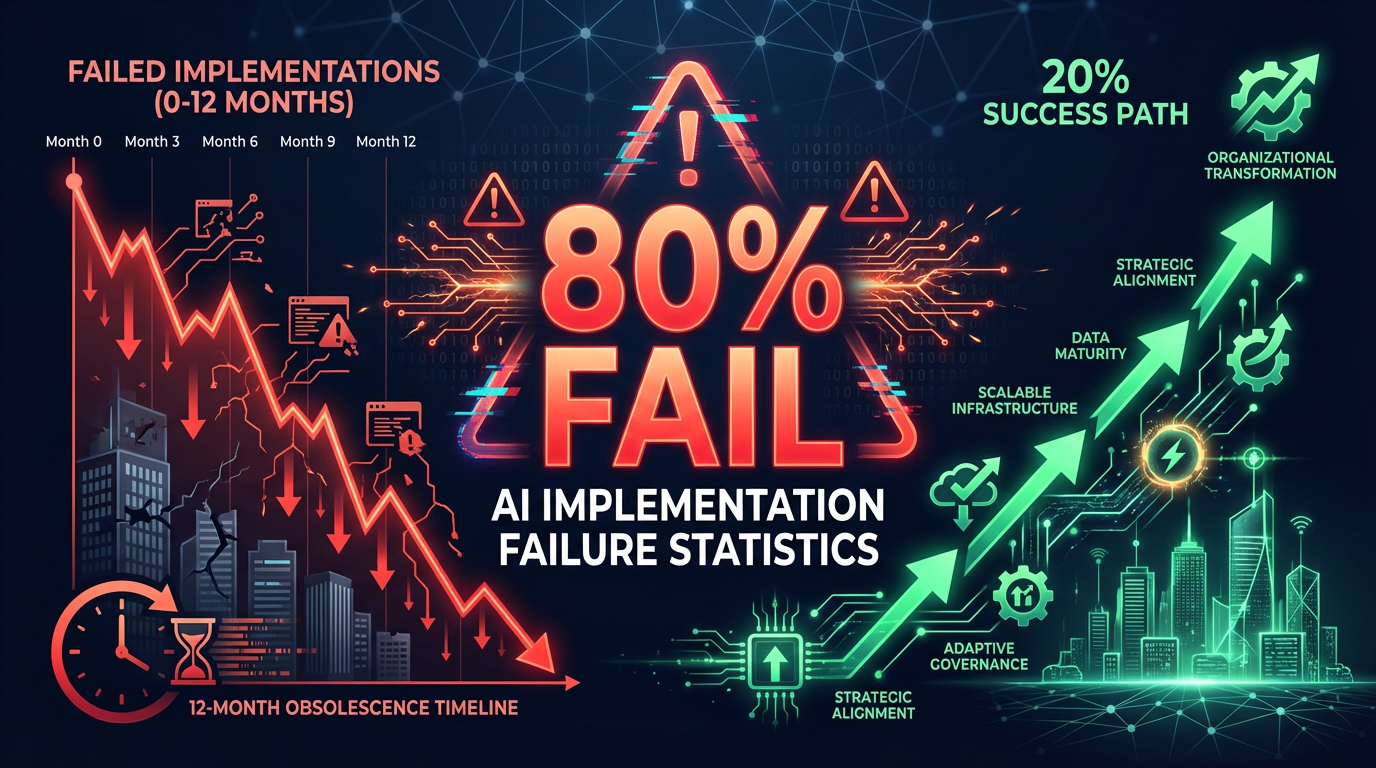
70-85% of AI implementations fail because SMEs treat AI as a technology purchase instead of organizational transformation. Success requires 3-6 months of foundational work (breaking silos, establishing data governance, aligning leadership) before deploying AI tools. Organizations building transformation capability first capture sustainable competitive advantages, while those rushing into AI waste 12-18 months cycling through failed pilots.
Key Facts:
- AI implementation failure rate is 70-85%, twice the rate of non-AI technology projects
- Main cause: Organizations skip foundational readiness and buy technology first
- Success formula: 3-6 months foundational work, then 8-12 months strategic AI implementation
- By mid-2026, markets will separate into AI-capable organizations versus those cycling through failed pilots
- The 30% who succeed treat AI as capability-building; the 70% who fail treat it as technology-buying
I've spent 20 years in marketing, 15 in digital transformation, and the last decade watching businesses struggle with technology adoption. What I'm seeing now with AI is different. The failure rate isn't high anymore. It's accelerating.
42% of companies abandoned most of their AI initiatives in 2025, up from 17% in 2024. The average organization scrapped 46% of AI proof-of-concepts before they reached production. This isn't a technology problem. It's a readiness crisis.
SMEs across the Middle East are being told "adopt AI now or become obsolete." The problem? This narrative is driving businesses toward failure, not transformation.
What is the Most Dangerous Misconception About AI Implementation?
The most dangerous misconception I see is this: AI is a technology purchase rather than an organizational transformation.
SMEs hear "implement AI" and immediately start shopping for tools. Chatbots, automation platforms, analytics software. They think buying the technology solves the problem. It doesn't.
I've watched businesses invest significant capital in sophisticated AI solutions only to have them sit unused or deliver zero ROI. The technology wasn't the issue. The organization wasn't structured to use it.
The technology is 20% of the equation.
What most SMEs have are siloed departments, inconsistent data practices, and no cross-functional collaboration framework. You drop AI into this environment and expect transformation? The AI exposes every operational dysfunction you've been ignoring.
According to Informatica's CDO Insights, data quality and readiness (43%), lack of technical maturity (43%), and shortage of skills and data literacy (35%) are the top obstacles to AI success.
Bottom Line: Technology represents only 20% of AI success. The remaining 80% depends on organizational readiness, operational foundation, and cultural transformation.
How AI Reveals Organizational Dysfunction
I worked with a mid-sized retail company in Dubai that wanted to implement AI-powered inventory management and demand forecasting. They were convinced this would solve their stock-out problems and reduce excess inventory costs.
The technology itself was solid. Sophisticated machine learning algorithms predicted demand patterns based on historical data, seasonal trends, market conditions.
Within the first month of implementation, the AI kept producing what they called "incorrect predictions."
What happened? The AI revealed their three regional managers were each using completely different criteria for categorizing products. Their sales team wasn't logging customer interactions consistently. Their warehouse system wasn't synced with their point-of-sale data.
The AI wasn't wrong. It was exposing the fact they had no unified data structure.
The Pattern of Blame and Recovery
They did what most SMEs do. They blamed the technology first.
The initial reaction was "this AI system doesn't understand our business" and "the vendor oversold the capabilities." There were conversations about switching to a different platform, finding a "better" AI solution.
Six weeks of frustration and a direct conversation later, they recognized the problem wasn't the algorithm. It was their operations.
To their credit, once they accepted that reality, they made the harder choice. They paused the AI implementation and invested three months in organizational groundwork.
They brought department heads together to create:
- Unified product categorization standards
- Consistent data entry protocols
- Integrated systems
- Cross-functional communication processes
It wasn't glamorous work. It was spreadsheets, meetings, process documentation, and change management.
When they reactivated the AI system after that foundation was built, it worked exactly as promised. Forecast accuracy improved by 34%, stock-outs decreased by 41%, and excess inventory costs dropped significantly.
Key Insight: AI implementation success comes from organizational transformation, not technology sophistication. A $50,000 failed pilot teaches this lesson the expensive way.
Why Does Rushing Into AI Implementation Cause Competitive Damage?
There's this narrative SMEs don't have TIME. If they don't adopt AI immediately, competitors will leave them behind.
This is the paradox destroying SME AI initiatives. The narrative of "adopt AI now or die" conflates speed with effectiveness, and this is misleading.
Your competitor who rushes into AI implementation without foundational readiness isn't gaining an advantage. They're wasting resources and creating organizational chaos.
I've seen businesses spend 12-18 months cycling through failed AI pilots, burning budget, exhausting their teams, and ending up where they started. Except now they're cynical about AI and resistant to future initiatives.
This isn't competitive advantage. This is competitive damage.
The real competitive threat isn't from businesses randomly deploying AI tools. It's from organizations taking 3-6 months to build transformation capability and then implementing AI strategically.
The Paradox: Competitors rushing into AI without readiness waste 12-18 months and create organizational chaos. The real threat comes from organizations taking 3-6 months to build transformation capability first.
What Separates Successful AI Implementations From Failures?
When I analyze successful implementations versus failures, the distinguishing factor is always sequencing.
The 30% who succeed treat AI as an organizational capability they're building. The 70% who fail treat it as a technology they're buying.
According to MIT and RAND Corporation research, 70-85% of AI initiatives fail to meet expected outcomes, with RAND finding over 80% of AI projects fail. Twice the failure rate of non-AI technology projects.
The Success Pattern
The organizations succeeding start with strategic assessment. They identify specific business outcomes they need, then they audit whether their organization supports AI integration.
They ask questions like:
- Do we have clean, accessible data?
- Can our departments collaborate effectively?
- Do we have leadership alignment on what success looks like?
- Do our people have the capacity to adopt new workflows?
Only after answering those questions do they select technology.
The failures do it backwards. They start with technology selection (often driven by vendor marketing or competitor anxiety) and then try to force their organization to adapt to the tool.
What Role Does Leadership Play in AI Success?
Successful implementations have executive sponsors who understand they're accountable for organizational change, not just technology deployment.
Failed implementations have executives who delegate AI to IT or innovation teams and expect them to deliver transformation without cross-functional authority or resources.
The 30% who succeed also share another characteristic. They measure differently. They're tracking adoption rates, process improvements, and capability development, not ROI in the first quarter.
According to Informatica's CDO Insights, winning programs invert typical spending ratios, earmarking 50-70% of the timeline and budget for data readiness (extraction, normalization, governance metadata, quality dashboards, and retention controls).
Success Pattern: The 30% who succeed start with strategic assessment and organizational audit before selecting technology. The 70% who fail start with technology selection and try to force organizational adaptation.
How is AI Implementation Different From Digital Marketing Adoption?
I get asked this a lot: "Why change when we've done digital and it has worked for us? And of course, what is it going to cost?"
Here's the critical distinction most SMEs miss. Digital marketing was an addition to your business model. AI is a transformation of your business model. They're different types of change.
When you adopted digital marketing 10-15 years ago, you added new channels. Social media, SEO, email campaigns, paid advertising. But your core operations stayed the same.
You were still selling the same products, managing inventory the same way, serving customers through the same processes. Digital marketing sat on top of your existing business and drove more traffic to it.
AI is different because it integrates into your operations, not just your marketing.
It changes how you forecast demand, manage supply chains, interact with customers, make decisions, allocate resources. When AI works, it doesn't bring you more customers. It changes your operational efficiency, your cost structure, your ability to scale, your competitive positioning.
What is the Real Cost of Not Implementing AI?
The cost question is backwards. The real cost isn't the AI investment. It's the cost of operating manually while your competitors are operating with AI-enhanced efficiency.
I've seen businesses spending 40% more on labor costs to accomplish what AI-integrated competitors do automatically. They're losing clients not because their service is bad. They lose because they don't respond fast enough, don't personalize at scale, don't compete on price because their cost structure is outdated.
Core Difference: Digital marketing was an addition to your business model. AI is a transformation of your business model because it integrates into operations, not just marketing channels.
What are the Unique AI Implementation Factors in the Middle East?
There are regional factors shaping AI readiness in the Middle East. Ignoring them is a mistake I see consultants make constantly when they try to apply Western frameworks without adaptation.
The Middle East has a distinct advantage in decision-making speed. In many organizations here, particularly family-owned businesses and SMEs, you have concentrated leadership authority.
When a CEO or owner decides to pursue transformation, they can mobilize resources and make structural changes much faster than in Western corporations with multiple approval layers and stakeholder consensus requirements.
This is a significant advantage if channeled correctly. You implement foundational changes in weeks rather than months.
But there's a corresponding challenge. The same concentrated authority bypasses the cross-functional collaboration AI implementation requires.
According to McKinsey's 2025 GCC AI survey, only 31% of GCC respondents said their organizations had reached AI maturity where AI was being scaled or fully deployed. Only 11% categorized their organizations as value realizers attributing at least 5% of earnings to AI.
Regional Advantage: Middle East SMEs benefit from concentrated leadership authority and less legacy technical debt. The challenge is channeling this for cross-functional collaboration rather than bypassing it.
Why is 18 Months a Critical Threshold for AI Implementation?
The 18-month threshold isn't arbitrary. It's based on what I'm seeing in implementation timelines and market maturation cycles.
Organizations starting to build transformation capability today need 3-6 months for foundational work. Breaking down silos, establishing data governance, aligning leadership, creating cross-functional frameworks.
Then another 8-12 months for strategic AI implementation, team adoption, process refinement, and measurable results. This is your 18-month cycle from decision to competitive advantage.
What happens at that threshold is a market separation point.
By mid-2026, you'll have two distinct categories of SMEs.
Category 1: Built capability, implemented AI strategically, and now operating with lower cost structures, faster response times, better customer personalization, and data-driven decision-making. They're capturing market share through operational superiority.
Category 2: Spent 18 months buying tools, running failed pilots, switching platforms, blaming vendors. They're back where they started. Except now they're cynical, their teams are exhausted, and they've burned budget with nothing to show for it.
According to Fivetran's 2025 report, 42% of enterprises say more than half of their AI projects have been delayed, underperformed, or failed due to data readiness issues. 29% cite data silos as blocking AI success.
Companies lose an average of $12.9 million annually due to poor data quality, much of it stemming from governance gaps.
Timeline Breakdown: Organizations need 3-6 months for foundational work, plus 8-12 months for strategic AI implementation. By mid-2026, markets separate into AI-capable organizations versus failed pilot-cyclers.
What Single Insight Prevents Most AI Implementation Failures?
AI implementation is not a sprint to deployment. It's a commitment to becoming a different kind of organization.
The single insight that would prevent most failures is this: you're not buying technology, you're building capability, and capability takes time, leadership alignment, and organizational honesty about your current state.
Most SME leaders approach AI like they approached digital marketing, as something you pilot, test, and scale if it works. But AI doesn't work this way.
You don't run a successful AI pilot in a dysfunctional organization any more than you test a high-performance engine in a car with a broken transmission. The pilot will fail, and you'll blame the technology when the real issue was readiness.
What I wish every leader understood is this: the businesses winning with AI right now aren't the ones who moved fastest. They're the ones who built the strongest foundations.
Critical Understanding: You're not buying technology, you're building capability. Capability requires time, leadership alignment, and organizational honesty about your current state.
Key Takeaways
- AI is organizational transformation, not technology purchase: Success depends 80% on organizational readiness and only 20% on technology sophistication.
- Foundational work precedes technology deployment: Organizations need 3-6 months breaking down silos, establishing data governance, and aligning leadership before deploying AI tools.
- The 30% vs 70% divide: Successful organizations treat AI as capability-building and start with strategic assessment. Failed organizations treat AI as technology-buying and start with vendor selection.
- Rushing creates competitive damage, not advantage: Competitors rushing into AI without readiness waste 12-18 months cycling through failed pilots while capability-builders capture sustainable advantages.
- By mid-2026, markets separate permanently: Organizations building transformation capability now will operate at 30-40% lower costs with measurable performance advantages.
- The real urgency is transformation capability: Don't buy AI tools immediately. Build transformation capability now so AI implementation works when you deploy it.
- Middle East SMEs have a window of opportunity: The region is in early-stage adoption with concentrated leadership authority and less legacy debt. Learn from global failures and build foundations now.
Ready to Build AI Transformation Capability?
Get your AI Readiness Assessment and learn how to build the organizational foundation for successful AI implementation.
Schedule Your AssessmentTags
Get AI Insights in Your Inbox
Join 1,000+ business leaders receiving weekly AI strategy insights, implementation guides, and Dubai market intelligence.