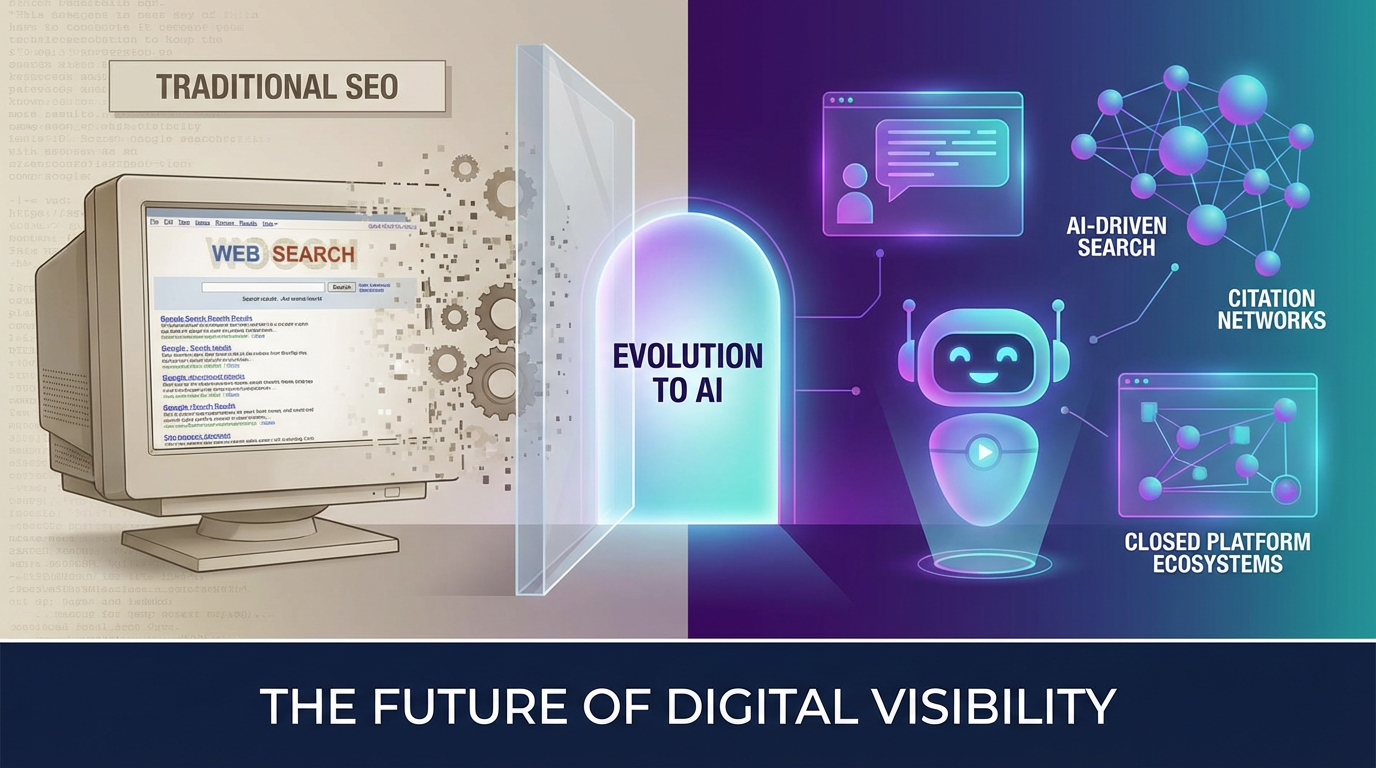
Why SEO in 2026 Isn't About Search Engines Anymore
Traditional SEO focused on Google rankings is becoming obsolete as AI agents and closed systems complete transactions without users visiting websites. By Q1 2026, businesses need to shift from search engine optimization to decision influence optimization by building citation-worthy presence in authoritative sources, integrating into closed ecosystems, and optimizing for AI training data rather than keyword rankings.
Core Answer
- AI agents complete transactions without clicks: 60% of Google searches in 2024 ended without a click, and AI systems now answer queries directly without sending users to websites.
- Citation economy replaces rankings: AI systems cite sources with third-party validation (industry reports, review sites, authoritative publications), not websites that rank well on Google.
- Closed systems control discovery: Enterprise procurement platforms, Salesforce, Microsoft 365, and other closed ecosystems make vendor decisions based on pre-approved databases, not open web searches.
- Training data cutoff problem: AI systems learn from 2024-2025 content. If you're not cited in authoritative sources now, you won't exist in AI recommendations when they go operational in Q1 2026.
- New metrics required: Track citation frequency, entity authority, ecosystem penetration, and attribution-adjusted revenue instead of traffic and rankings.
Something Was Broken Around Mid-2024
Clients kept celebrating their SEO wins. First page rankings, 40% traffic increases, all the metrics we'd been trained to worship.
But their revenue wasn't moving. Lead quality was declining.
When I dug into the customer journey, I found something unsettling. Their buyers weren't using Google anymore.
I had one B2B SaaS client ranking number one for their primary keyword. Traffic was up significantly. Conversions were flat.
The problem? Their buyers (C-suite executives) were asking ChatGPT for recommendations, checking review sites, and getting referrals from their networks. They weren't clicking through ten blue links.
The entire customer journey had shifted, but the SEO strategy was still optimized for 2019 behavior.
We were solving for the wrong problem. Traditional SEO assumes people will search, click, and visit your site. But agentic AI and closed systems are completing those tasks without the click ever happening.
According to recent data, 60% of Google searches ended without a click in 2024. That's more than 3 trillion searches where visibility didn't translate to action.
Businesses are pouring resources into a strategy that optimizes for user behavior that's rapidly disappearing.
What Happens When AI Completes the Transaction Without Clicks
The new customer journey looks like this:
A CEO needs a marketing automation platform. Instead of Googling "best marketing automation software" and clicking through comparison articles, they open ChatGPT or Claude and ask: "What's the best marketing automation platform for a 50-person B2B company in healthcare with a $50K budget?"
The AI doesn't send them to websites. It synthesizes an answer from its training data, pulls from authoritative sources it trusts, and delivers a recommendation directly.
The AI suggests HubSpot, Marketo, and ActiveCampaign with specific reasoning. The executive gets their answer in 30 seconds.
No clicks. No website visits. Transaction complete.
What traditional SEO misses:
- There's no keyword to rank for
- There's no search result to optimize
- There's no page to land on
Your website could rank number one for "marketing automation healthcare" and it's completely irrelevant because that search never happened.
The AI made the recommendation based on what it learned during training. Your visibility depends on whether you were cited in authoritative content that the AI ingested months or years ago.
Research shows that analysis of over 650 ChatGPT queries reveals overlaps of only 8-12% between ChatGPT citations and Google SERP results. ChatGPT runs on different signals than Google.
If your brand isn't mentioned in places that AI systems trust (industry publications, review sites, case studies, third-party analyses), you don't exist in this new discovery paradigm.
Bottom Line: AI systems recommend based on training data, not real-time search rankings. If you weren't cited in authoritative sources during training, you're invisible when decisions get made.
How the Citation Economy Works
Most marketers hear "citation-worthy content" and think "let's write a 3,000-word blog post with great insights."
That's still content created for human readers on your own website.
Citation-worthy content means becoming a source that other authoritative voices reference and quote.
What AI systems cite:
- Industry reports with third-party validation
- Peer-reviewed analyses
- Case studies published on authoritative platforms
- Expert commentary in established publications
- Data that gets referenced across multiple sources
AI systems don't randomly cite your blog. It's about being quoted, not being quotable.
Real Example: Logistics Client Case Study
I worked with a client in the logistics space. Instead of pumping out SEO blog content on their own site, we shifted strategy:
- Got them featured in industry publications like Supply Chain Quarterly
- Helped them contribute data to Gartner reports
- Positioned their CEO as a source for journalists writing about supply chain AI
- Got their methodology cited in academic papers
Result: Six months later, when someone asks an AI system about logistics optimization, our client gets mentioned. Not because they ranked well on Google, but because they became a referenced source in the training data.
The AI cites them the same way it would cite McKinsey or Forrester because they appeared in the same authoritative contexts.
You're optimizing for being quoted in someone else's content, not for ranking with your own.
Key Insight: AI systems cite sources with third-party validation. Your owned content needs to appear in authoritative publications that AI systems trust and reference during training.
How Mid-Sized Companies Get Cited by AI Systems
The first move is counterintuitive. Stop trying to be the authority and start becoming the data source.
Mid-sized companies won't out-brand McKinsey, but they'll out-specialize them with proprietary insights that larger firms won't bother with.
Step 1: Identify Your Unique Data Point
Find a specific, measurable insight from your client work that no one else is tracking. Not generic industry trends. Something you uniquely observe because of your position in the market.
For us at Neural Horizons AI, it was tracking agentic AI adoption rates across Middle Eastern SMBs. Nobody else was measuring that specific intersection.
Step 2: Package Data for Journalists and Analysts
We created a quarterly benchmark report. Nothing fancy. Real numbers from our client base.
Then we proactively pitched it to three groups:
- Industry journalists who cover our space
- Analysts at research firms who publish reports
- Academic researchers studying AI adoption
We made it free, shareable, and citeable with proper methodology.
Step 3: Get Referenced in Authoritative Content
Within two quarters, our data started appearing in other people's content:
- A journalist writing about AI in emerging markets cited our numbers
- A research firm referenced our benchmarks in their report
We weren't another consultancy anymore. We were a data source.
When AI systems ingested those articles and reports, our name came with the citation.
The Strategy: You're not asking anyone to write about how great your company is. You're offering something they need: credible, specific data they won't get elsewhere.
That's how a 50-person company gets cited alongside the big names. You become useful to the people who are already authoritative, and you inherit their credibility by association.
Key Insight: Become the source that authoritative publishers reference. Offer proprietary data that journalists and analysts need, and your citations will follow into AI training data.
Why Q1 2026 Is the Critical Deadline
Q1 2026 is when we hit critical mass on agentic AI adoption. These systems move from experimental to operational for mainstream businesses.
Deloitte predicts that 25% of companies currently using generative AI will launch agentic AI pilots in 2025, with that number growing to 50% in 2027. We're already seeing early adopters, but Q1 2026 is when the laggards realize they've waited too long.
What's Converging in Q1 2026
- Next-generation AI models: GPT-5 and the next generation of reasoning models are expected to launch late 2025 or early 2026. These aren't better chatbots. They're systems that complete multi-step business processes autonomously. Book a vendor, negotiate terms, compare options, make purchases.
- Enterprise platform integration: Major platforms like Microsoft, Google, and Salesforce are embedding these agents directly into their enterprise tools. By Q1 2026, your competitor's AI agent will be evaluating vendors and making shortlists without a human ever visiting your website.
The Training Data Cutoff Problem
Why you need to prepare now:
If you're not already cited in authoritative content that these AI systems are ingesting during their training cycles, you won't exist in their recommendations when they go live.
You won't optimize for an AI agent in real-time the way you could tweak a Google Ad campaign. The AI's knowledge base is already being built right now from 2024 and 2025 content.
Two paths forward:
- Start now: Build citation-worthy presence (industry publications, referenceable data, review platforms). You'll be in the AI's knowledge base when it matters.
- Wait until Q1 2026: Spend the next two years trying to catch up after competitors are already embedded.
You won't shortcut your way into training data that's already been ingested.
Key Insight: AI systems are being trained on 2024-2025 content right now. If you're not building authoritative presence today, you won't exist in AI recommendations when they go operational in Q1 2026.
What to Measure Instead of Traffic and Rankings
If an AI agent recommends you and completes a transaction without anyone visiting your website, all your traditional metrics show zero activity while you acquired a customer.
Track influence metrics, not traffic metrics.
Four Critical KPIs for AI-Driven Discovery
1. Citation Frequency
How often is your brand mentioned in authoritative sources that AI systems ingest?
Track: Media mentions, industry report inclusions, review platform presence, academic citations
2. Entity Authority
How is your company and your experts being recognized across platforms?
Track: Executive quotes as sources, data references, industry database listings, verified reviews
3. Ecosystem Penetration
Are you present in the closed systems where your buyers operate?
Track: Integration partnerships, vendor database inclusions, platform certifications, API connections
4. Attribution-Adjusted Revenue
Implement tracking that captures "How did you first hear about us?"
If the answer is "ChatGPT recommended you" or "You came up in our internal AI vendor analysis," that's a conversion that your analytics will never capture through traditional tracking.
Attention vs. Influence
Traffic measures attention: How many people saw you.
Influence measures impact: How many decisions were affected by your presence, even if those people never clicked.
Research shows that we're already seeing three to eight times higher conversion rates from traffic originating in AI search, proving that influence metrics matter more than traffic volume.
Key Insight: AI-driven transactions bypass traditional analytics. Track citation frequency, entity authority, ecosystem penetration, and attribution-adjusted revenue instead of traffic and rankings.
Why Closed Systems Control Discovery More Than Open Web Search
Agentic AI is the mechanism (the "how" of automated decision-making). Closed systems are the environment (the "where" it happens).
Together, they create a new visibility challenge.
Where Agentic AI Operates
Agentic AI doesn't operate in the open web the way Google does. It operates within platforms:
- Salesforce
- Microsoft 365
- Enterprise procurement systems
- ChatGPT's ecosystem
These are closed systems where the AI has access to specific data sources, specific integrations, specific approved vendors.
Your website being public and Google-indexed means nothing if the AI agent making purchasing decisions only has access to pre-approved data within that closed system.
Real Example: Enterprise Software Procurement
I have a client in the enterprise software space. What happens when a potential customer's AI agent needs a solution:
- AI agent operates within their procurement platform
- Agent queries the approved vendor database within the procurement system
- Cross-references with the company's existing tech stack integrations
- Checks review scores from G2 or Gartner embedded in the platform
- Generates a shortlist
The entire process happens inside that closed ecosystem.
If you're not in that system's approved vendor list, integrated with their APIs, and rated on their preferred review platforms, you won't be discovered. No matter how good your SEO is.
Key Insight: AI agents operate inside closed platforms with pre-approved vendor lists and specific integrations. Open web visibility means nothing if you're not embedded in the closed systems where your buyers make decisions.
The Most Dangerous Mistake Companies Are Making Right Now
The most dangerous mistake is what I call "optimization paralysis." Businesses waiting to see how this plays out before they act.
They're watching agentic AI developments, reading about ChatGPT updates, attending webinars about the future of search. But they're not doing anything because they want certainty first.
By the time they have certainty about how this works, the window to establish presence has closed.
Why Waiting Is Fatal
AI systems are being trained right now on 2024 and 2025 content. If you're not building citation-worthy presence today, you won't exist in the knowledge base when these systems go operational in Q1 2026.
You won't retroactively become an authoritative source that was referenced six months ago.
I'm seeing competitors in our space still running traditional SEO playbooks (keyword research, link building, content calendars optimized for Google) because that's what they know and it still shows some results.
But they're ignoring the fact that their future buyers are already asking AI systems for recommendations, and those systems have never heard of them because they're not cited anywhere that matters.
This Isn't a Marketing Tactic
Companies think they'll bolt on "AI optimization" as a marketing tactic later.
But this requires fundamental changes:
- Getting into vendor databases
- Building integration partnerships
- Establishing systematic presence in authoritative publications
- Creating referenceable data assets
That's not a three-month marketing campaign. That's an 18-month infrastructure build.
The Widening Gap
In 18 months, you'll have two groups:
- Early movers: Companies that spent 2024-2025 building foundational presence and ecosystem integration
- Late reactors: Companies starting to panic because their traditional metrics are collapsing and they're invisible to AI systems
The gap between those two groups will be nearly impossible to close because you won't shortcut credibility and you won't hack your way into training data that's already been ingested.
Key Insight: Waiting for certainty means missing the training data window. AI systems are learning from 2024-2025 content now. If you're not building presence today, you won't exist in their knowledge base tomorrow.
Why This Shift Is Already Happening
I usually start by asking clients to describe their last significant purchase decision. Whether it was choosing a software vendor, hiring a consultant, or even buying something expensive personally.
Then I ask: "Did you start with a Google search and click through ten results, or did you ask someone you trust, check a specific review platform, or use an AI assistant?"
Almost always, they realize they didn't use traditional search. They asked ChatGPT, they checked G2 reviews, they got a referral from their network, they used a recommendation engine within a platform they already trust.
They're optimizing their business to be found in a way they themselves don't even search anymore.
The Data Backs This Up
More than a quarter of people surveyed in the US reported using AI tools instead of traditional search engines.
A 2024 Salesforce study found that 33% of consumers would rather purchase through an AI agent than interact with a person, and 24% of consumers are already comfortable with AI agents shopping for them. Among Gen Z, that number rises to 32%.
Where Your Best Customers Are Coming From
When I show clients their analytics and we look at traffic sources, conversion paths, and customer acquisition channels, we inevitably find that their highest-value customers didn't come through organic search.
They came through referrals, direct traffic from AI recommendations, or platform integrations.
Their best business outcomes are happening outside the traditional SEO funnel, but they're still pouring 80% of their marketing budget into optimizing for that funnel.
The window is closing, but it hasn't closed yet.
Key Insight: Consumer behavior has already shifted. Your best customers aren't finding you through traditional search. The businesses that adapt now will capture the Q1 2026 inflection point, while those who wait will face an insurmountable gap.
Key Takeaways
- AI agents complete transactions without clicks: 60% of Google searches in 2024 ended without a click. AI systems answer queries directly and recommend vendors based on training data, not real-time search rankings.
- Citation economy replaces keyword rankings: AI systems cite sources with third-party validation (industry reports, review sites, authoritative publications). Get quoted in someone else's content, not ranked with your own.
- Closed systems control enterprise decisions: AI agents operate inside platforms (Salesforce, Microsoft 365, procurement systems) with pre-approved vendor databases. Open web visibility means nothing if you're not embedded in closed ecosystems.
- Training data cutoff is happening now: AI systems learn from 2024-2025 content. If you're not cited in authoritative sources today, you won't exist in AI recommendations in Q1 2026. You won't retroactively enter training data.
- Optimization requires pattern recognition, not real-time iteration: Build consistent presence across authoritative sources over 12-18 months. AI learns patterns from multiple citations, not individual page tweaks.
- Measure influence, not attention: Track citation frequency, entity authority, ecosystem penetration, and attribution-adjusted revenue. Traffic volume means nothing if AI agents complete transactions without website visits.
- Early movers build insurmountable advantages: Businesses that build authoritative presence in 2024-2025 will have trust signals in AI systems that take years to replicate. Late movers face permanent gaps.
At Neural Horizons AI, we're making sure our clients are on the right side of that divide before the window closes completely. The compounding advantage of early positioning is real, and every month of delay makes the recovery path longer and more costly.
Tags
Get AI Insights in Your Inbox
Join 1,000+ business leaders receiving weekly AI strategy insights, implementation guides, and Dubai market intelligence.