I don't cover AI news for the sake of covering AI news. I cover it when something genuinely moves the needle — when a development shifts the landscape in a way that matters to the businesses and leaders I work with across the UAE, MENA, and globally. This week had four of those moments. Let me take you through each one.
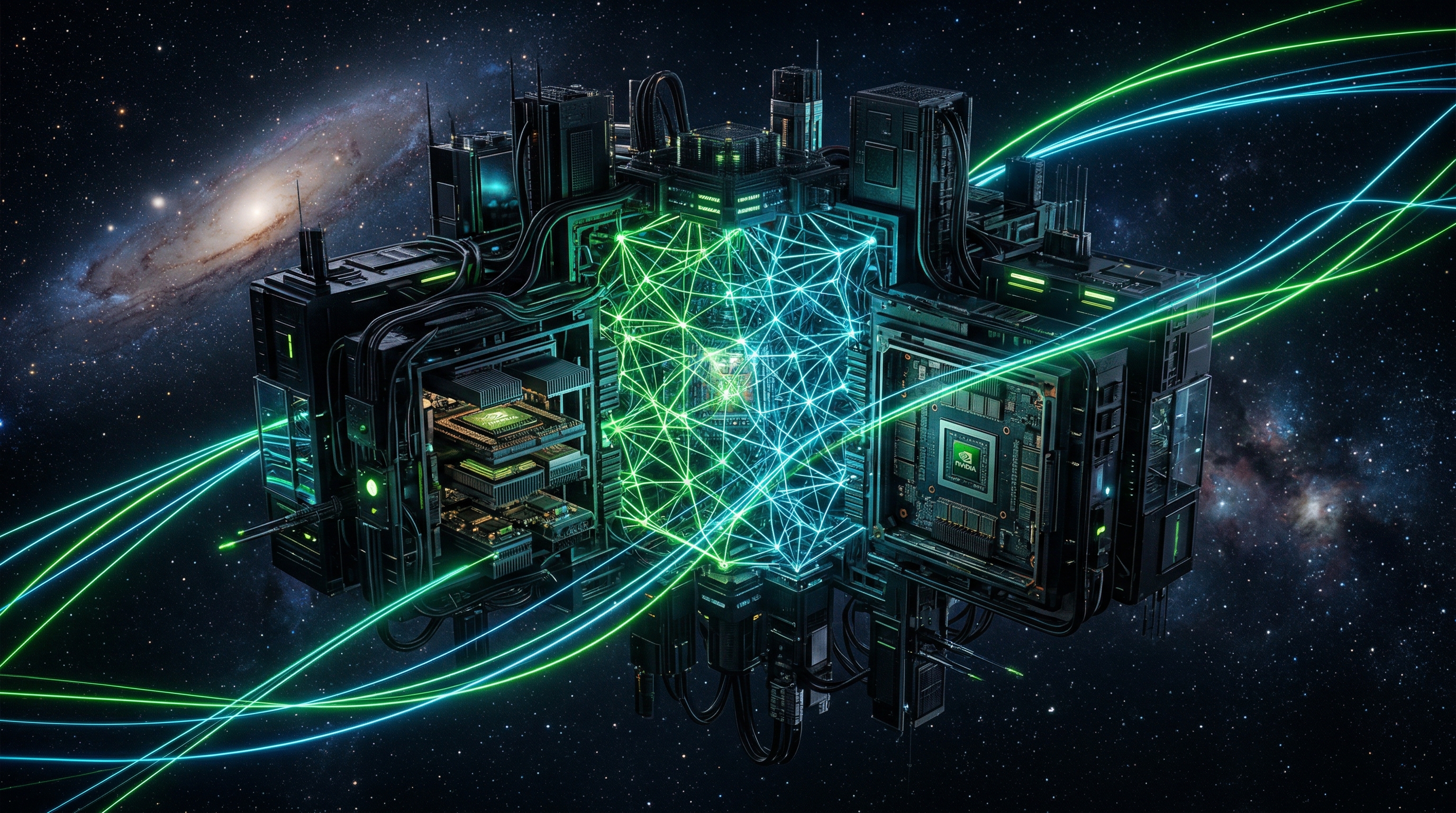
Nvidia just released Ising — a family of open-source AI models built to work directly with quantum hardware. Not to simulate quantum computing. Not to help researchers write quantum code. To actually run inside quantum machines and solve the two problems that have been holding the whole technology back: calibration and error correction.
The calibration model automates quantum machine tuning — a process that previously took days of specialist work and now takes hours. The error correction model fixes mistakes during live computation, running 2.5 times faster and three times more accurately than anything else available in open source. Harvard, Cornell, Fermilab and IonQ are among the 20+ institutions already using it at launch.
"The operating system of quantum machines."
Jensen Huang's framing is deliberate. He's not describing a tool. He's describing infrastructure — the foundational layer that everything else runs on top of. And he's releasing it for free.
This is the same playbook Nvidia ran with autonomous vehicles and robotics. Release the open AI layer, make it the default, lock in the ecosystem, and own the hardware that runs underneath it. The quantum computing market is projected to hit $11 billion. Nvidia isn't waiting to see who wins. It's planting its flag now — before serious enterprise competition arrives — and doing it in a way that makes every other quantum lab dependent on Nvidia infrastructure to operate.
Quantum computing has always felt like a "10 years away" technology. Nvidia just made it feel like 3. You don't need to build a quantum strategy today — but you do need someone in your leadership team tracking this. The businesses that understand what quantum-AI integration will do to optimisation, simulation, drug discovery, and financial modelling will have a significant head start. The ones who ignore it until it's mainstream will spend three years catching up.

OpenAI has released a cybersecurity-focused AI model and made it available to thousands of organisations. The contrast with Anthropic couldn't be more deliberate. Anthropic's equivalent — Mythos — is locked behind a 40-organisation whitelist. Two companies, same category, completely opposite distribution strategies.
- OpenAI's bet: Scale beats precision. Get the model into thousands of security teams, gather real-world threat data at massive volume, improve faster than any restricted deployment ever could. The moat is data and ecosystem lock-in.
- Anthropic's bet: Controlled deployment beats wide release for high-stakes AI. By limiting Mythos to 40 vetted organisations, Anthropic controls the use cases, the outputs, and the liability. The moat is trust and governance.
Both strategies are internally coherent. OpenAI is optimising for reach, adoption, and data velocity. Anthropic is optimising for reputation, control, and enterprise trust. The question — which nobody can answer yet — is which model of AI governance will win in the regulated industries that matter most: finance, healthcare, government, and critical infrastructure.
If you're operating in a regulated industry in the UAE or MENA — financial services, healthcare, government, energy — this strategic divergence matters enormously for your vendor selection. OpenAI's open approach gives you scale and speed. Anthropic's restricted approach gives you governance credibility with regulators. This isn't a technology decision. It's a risk and compliance decision. Make it consciously — not by default.
While everyone is watching Anthropic's restricted Mythos deployment, they're also quietly building something more immediately significant for any business that writes software: Claude Code. Not just a code completion tool. A command centre designed for development teams where AI and humans work together in real time — shared context, shared codebase, shared decision-making.
The implication is a fundamental shift in how software teams are structured. The question is no longer "how many developers do I need?" It's "how many human developers do I need for the parts AI can't own autonomously?" That's a different workforce and resourcing calculation entirely.
If a hybrid human-AI dev team using Claude Code can produce the output of a team twice its size, what does that do to hiring plans? To team structures? To the way you scope projects and estimate timelines? These are not hypothetical questions for 2030. They are live operational questions for any technology leader making resourcing decisions right now.
I'm seeing this play out with my clients already. The technology teams that are integrating AI agents into their development workflow are not replacing developers — they're multiplying what each developer can ship. The ones who haven't started yet are starting to feel the gap. If your tech leadership isn't actively experimenting with agentic development tools in 2026, that conversation needs to happen in your next leadership meeting.
The fourth story is the smallest in scale but the most immediate in its day-to-day impact. Google Chrome is introducing AI Skills — saved prompts that turn your most-used AI interactions into reusable, one-click shortcuts directly in your browser.
On the surface this sounds minor. It isn't. Think about how many times a day your team opens an AI tool, types the same kind of prompt, and copies the output somewhere. A brief. A summary. A rewrite. A translation. A data extract. Chrome Skills compresses that workflow into a single click — and because it lives in the browser, it's available on any page, with any content, without switching tabs or copying text between tools.
If each person on your team runs 10–15 repetitive AI interactions per day, and Chrome Skills removes 80% of the friction from each one, you're looking at a meaningful daily time saving across every knowledge worker in your business. Multiplied across a team of 20, that's hundreds of hours per month recovered. This is not a feature. It is a workflow transformation hiding inside a browser update.
Start building your prompt library now. When Chrome Skills ships widely, the businesses that already have a curated set of high-value, battle-tested prompts will be able to deploy them across their entire team in minutes. The ones starting from scratch will spend months experimenting. Build the library now. It's one of those rare things that takes very little investment and compounds in value over time.
The Bottom Line This Week
- Nvidia + Quantum: The 10-year timeline just got shorter. You don't need a quantum strategy today — but you need someone on your leadership team tracking it.
- OpenAI vs Anthropic on cybersecurity: Two completely different governance bets. In regulated industries, your AI vendor choice is now a compliance decision as much as a technology one.
- Claude Code: The hybrid human-AI dev team is not a future concept. It's being deployed now. If your tech leadership isn't experimenting with agentic development tools, the conversation is overdue.
- Chrome Skills: Build your prompt library now. When this ships widely, organisations with tested prompts win. Don't start from scratch when everyone else already has a head start.
Get Friday AI Insights — Every Week
No fluff. No spam. Just the AI stories that matter for your business, with Lisa's take on what they mean for you — straight to your inbox every Friday.
Join leaders across the UAE & beyond. Unsubscribe anytime.