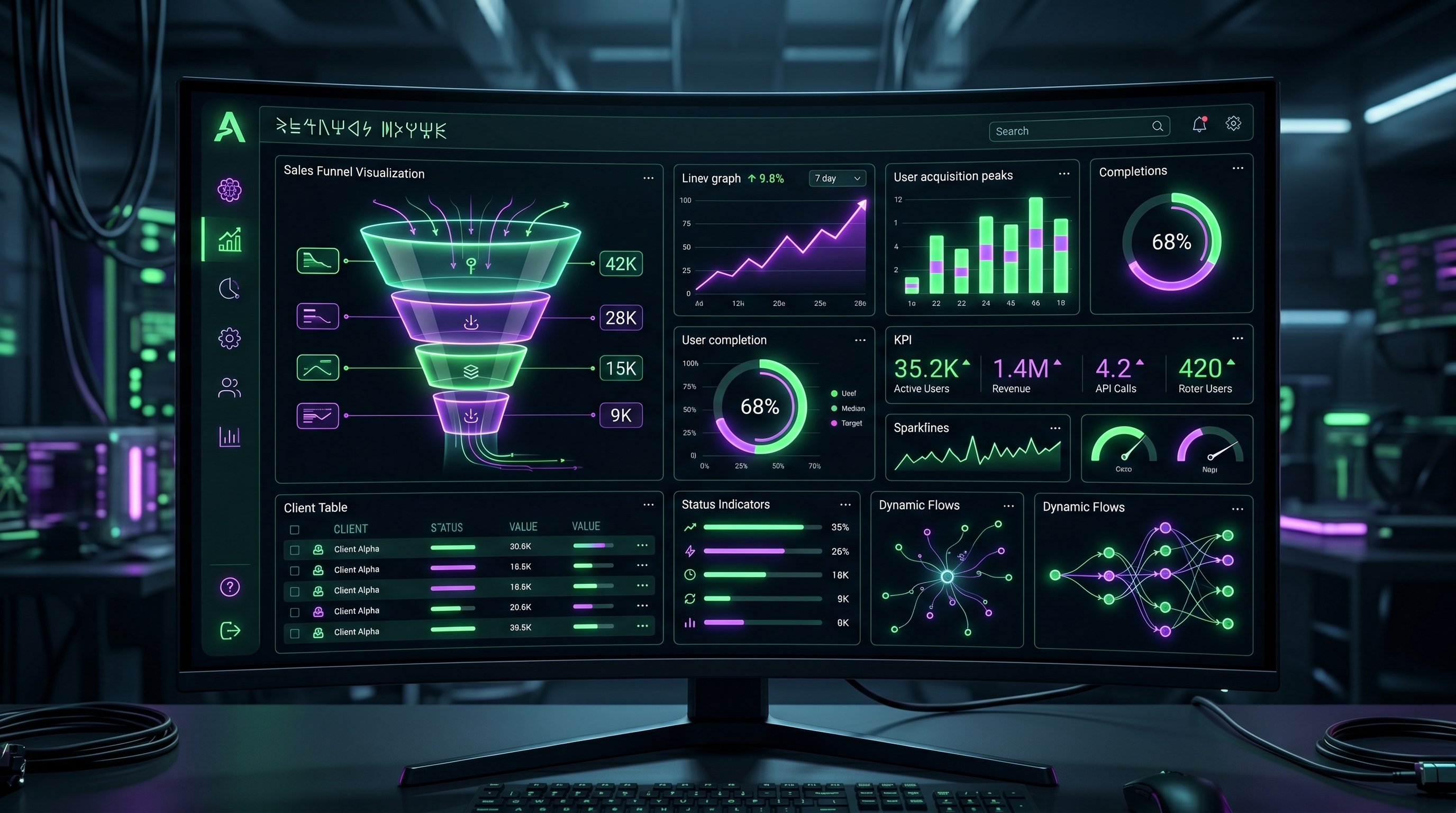
I've sat in a lot of boardrooms in Dubai and Abu Dhabi. I've reviewed a lot of AI roadmaps. And I keep seeing the same thing: organisations that have invested significantly in AI tools but are getting a fraction of the return they expected.
When we dig in, the root cause is almost always the same. It's not the model. It's not the data science team. It's not the budget. It's the fact that the AI they've deployed exists in complete isolation from the rest of the business. Sales bought a lead-scoring tool. Marketing adopted a content generation platform. Operations is running a separate forecasting model. And none of these systems talk to each other. None of them share context. None of them close the loop.
This is what I call the silo problem — and it is killing AI ROI across the region.
"The problem isn't that companies aren't adopting AI. It's that they're adopting it in fragments — tool by tool, team by team — and wondering why nothing changes at scale."
How AI Adoption Actually Happens (And Why It Breaks)
The typical AI adoption pattern looks like this: a department head sees a demo, gets excited, gets budget approval, buys a tool, and runs a pilot. The pilot shows promising results. Leadership approves wider rollout. Six months later, the tool is being used — but only within that department, only for that department's data, and only for that department's workflows.
Meanwhile, three other departments have done exactly the same thing with three different vendors. You now have a fragmented AI estate — five or six point solutions, each optimised for a narrow task, each working with its own slice of the business data, and none of them interacting.
The result? You've automated isolated tasks, not transformed processes. Your AI tools are digital islands. And the gaps between departments — where the real business value lives — remain completely untouched.
In my experience across UAE and MENA markets, this pattern is not the exception. It is the norm. Companies that have been "doing AI" for two or three years are often no more integrated than when they started. They've just accumulated more tools.
Why Traditional AI Can't Solve This
Here's the uncomfortable truth: most of the AI tools on the market today — even the powerful ones — are designed to be siloed. They're built to do one thing well. A great CRM AI scores leads. A great marketing AI generates copy. A great operations AI predicts demand. None of them were architected to span organisational boundaries, because that's not how enterprise software is sold.
Large language models don't solve this either. Deploying a company-wide ChatGPT instance gives everyone access to a smart text tool — but it doesn't connect your CRM to your marketing automation to your ERP to your customer service platform. It doesn't perceive what's happening across the business and take coordinated action. It answers questions. That's different.
The same goes for robotic process automation. RPA is great at moving data between fixed systems along pre-programmed paths. But it's brittle, it can't reason about new situations, and it certainly can't orchestrate complex, multi-step decisions across departments in real time.
What breaks silos is not a smarter chatbot or a faster automation. What breaks silos is an agent — something that can perceive context across systems, make decisions, and take action autonomously across the whole process.
"An LLM answers questions. An agentic AI acts — across your CRM, your marketing platform, your ops systems, and your reporting stack — without a human handoff at every step."
What Agentic AI Actually Means
Agentic AI is not a buzzword I use loosely. It refers to AI systems that can perceive context, reason about it, make decisions, and execute actions — across multiple systems, autonomously, without requiring a human to hand off from one step to the next.
Let me make that concrete. Imagine a sales agent built on an agentic framework. When a high-value prospect engages with your website:
- The agent reads the CRM record — deal stage, contact history, previous proposals, sentiment from past emails
- It cross-references the marketing platform — which content this prospect has consumed, their engagement score, campaign touchpoints
- It updates the pipeline — adjusts the deal probability, flags the account to the sales lead
- It triggers a personalised outreach sequence — tailored to where this prospect actually is in their journey, not just what stage they're in on a spreadsheet
- It flags a deal risk if the engagement pattern matches previous churned accounts — before the rep even notices
- All of this happens without a single human handoff. The sales rep wakes up to a briefing, not a to-do list.
That is what agentic AI can do. It doesn't just automate a task — it orchestrates an end-to-end workflow across multiple systems, with reasoning and decision-making at each step. That's categorically different from anything a chatbot or an RPA tool can do.

The Three Silo Patterns I See Most in UAE and MENA
After working with businesses across Dubai, Abu Dhabi, Riyadh, and wider MENA, three silo patterns come up again and again. Every organisation has its own flavour, but these are the archetypes:
1. Sales vs Marketing Data Disconnect
The marketing team is generating leads and tracking engagement in their platform. The sales team is working those leads in a CRM. The two systems rarely sync in real time, and when they do, it's a manual export-import process that's already out of date. The result: sales doesn't know what marketing has told a prospect; marketing doesn't know what sales has promised. The customer experience is disjointed. The pipeline data is unreliable. AI tools deployed in each department are optimising against the wrong inputs — because each is working from an incomplete picture of the customer.
2. Operations vs Customer-Facing Disconnect
Operations knows about supply constraints, delivery delays, capacity issues, and cost pressures. Customer-facing teams — sales, account management, customer service — are the last to know. They're making commitments and promises to customers based on information that ops discarded two weeks ago. When AI is deployed in this environment, it amplifies the problem. The customer service AI is generating confident responses based on stale data. The sales AI is recommending products that operations can't deliver on time. The gap between what the company knows and what it communicates becomes a liability.
3. Leadership vs Ground-Level Reality Disconnect
This one is the most dangerous — and the most common. Leadership is making AI investment decisions based on dashboards that aggregate data from multiple systems. But those systems don't talk to each other, so the dashboards are full of gaps, reconciliation errors, and lag. The AI tools deployed at the operational level are generating insights that never make it to the C-suite in a useful form. Strategy is being set against a distorted picture of reality. And when things go wrong — when a market shifts, when a key client churns, when an operational risk materialises — leadership is always the last to know.
The Neural Horizons Framework: Diagnose → Map → Connect → Automate
When clients come to me with AI implementations that aren't delivering, I don't start by recommending new tools. I start by diagnosing where the silos are — and what they're costing the business. Here's the framework we use:
"Agentic AI doesn't just speed up what you're already doing. It changes the architecture of how work gets done — which means it also changes the architecture of where value is created."
What to Expect — and What Not To
I'm going to be direct here, because I've seen too many businesses set themselves up for disappointment by treating agentic AI as a magic solution. It is not. It is a powerful tool that requires the right conditions to work.
- Clean data. Agents reason from the data they have access to. If your CRM is full of duplicates, your pipeline data is manually entered and inconsistent, or your marketing platform hasn't been properly integrated — your agent will make decisions based on bad inputs. Garbage in, garbage out applies here at speed and at scale.
- Clear process ownership. Someone needs to own each process the agent is orchestrating. When an agent flags a deal risk, who is responsible for acting on it? When the agent updates a pipeline stage, who reviews it? Agentic AI removes human handoffs — but it doesn't remove human accountability. You still need clear ownership of outcomes.
- Change management. Your teams will need to work differently. Sales reps who used to manually qualify leads will need to trust agent-generated scoring. Marketing teams who used to control every campaign trigger will need to cede some of that control. Operations leads who managed exceptions manually will need to respond to agent-generated flags. This is a cultural and behavioural change, not just a technical one. Ignore it and you'll have a brilliant agent that nobody uses.
What agentic AI can realistically deliver — once those conditions are met — is significant: faster cycles, fewer handoffs, earlier risk detection, more consistent customer experiences, and leadership visibility that reflects what's actually happening in the business rather than what was true last Tuesday.
I've seen clients cut their lead response time from days to minutes. I've seen sales and marketing alignment that used to require weekly reconciliation meetings become automatic. I've seen operational risk flags surface to leadership weeks before they would have been visible through traditional reporting. None of this happened overnight. But it happened — and it happened because we built on a foundation, not because we bought another tool.
Key Takeaways
- 70–85% of AI implementations fail because companies adopt AI tool-by-tool, department-by-department — creating silos, not solutions.
- Traditional AI tools (LLMs, RPA, point solutions) are designed for isolated tasks. They cannot orchestrate end-to-end workflows across departments by design.
- Agentic AI is categorically different: agents that perceive context, make decisions, and take action across multiple systems — autonomously, without human handoffs at every step.
- The three most common silo patterns in UAE/MENA: Sales vs Marketing data disconnect, Operations vs Customer-facing disconnect, Leadership vs Ground-level reality disconnect.
- The Neural Horizons framework: Diagnose → Map → Connect → Automate. Never skip the "Connect" step. Clean, connected data is the foundation agentic AI runs on.
- Agentic AI requires clean data, clear process ownership, and real change management. It is not a plug-and-play solution — but when conditions are right, the results are transformational.